
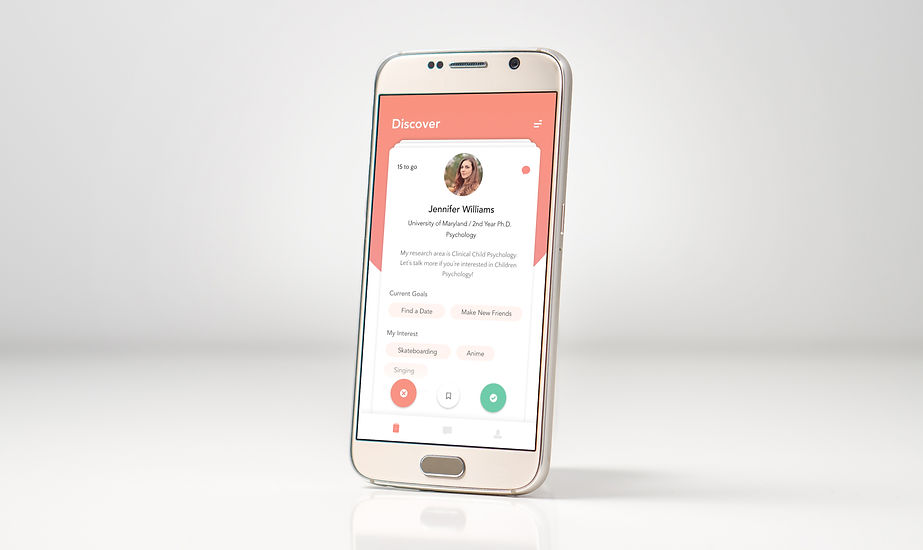
Pair
Peer-to-peer connection app for Ph.D. students; share personal and academic interests to foster deep connections and reduce loneliness.
Team
Yirang Choe, Natalie Yeh, Modassir Iqbal
Project Duration
February - May, 2019 (3 months)
My Role
UX Research, UI Design
Project Type
Class Project
Loneliness is a common yet serious issue today
The main objectives of this project are as follows:
1) Understand if and how the life of a Ph.D. student affects the levels of loneliness he or she feels
2) Devise a solution to help them feel less lonely in their day to day life
What is Pair?
* Video Prototype of Pair
Project Process
 1.Background ResearchStudy root causes of loneliness and existing solutions |  2.SurveyUnderstand their lifestyle and emotional state |  3.InterviewIdentify factors that drive the levels of loneliness |
|---|---|---|
 4.Diary StudyCapture in-the-moment data from the students |  5.Data AnalysisAnalyze collected quantitative and qualitative data |  6.IdeationBrainstorm for solutions |
 7.Validating the ideaValidate problem-solution fit, search for new solution idea |  8.Focus GroupValidate the new idea with potential users |  9.PrototypeDevelop and iterate the design and features |
 10.Video PrototypeTell a story of how the product fits into the users life |
Background Research / Survey
We read and studied literature reviews and published articles to understand the issues of loneliness among students and underlying root causes. We then looked for existing solutions that alleviate loneliness; this process helped us screen the optimal user group for the study.
*The prevalence of anxiety and depression within the population of graduate students studied
According to Natural Biotechnology, from a total of 2,279 students (90% Ph.D. students) 41% of respondents showed signs of moderate to severe depression.

From the background research, we learned that Ph.D. students are the prime candidates for this study as they often face a high level of loneliness due to their external environments (working in solitude, juggling classes and TA work, high pressure to publishing research papers, etc.).
Based on this finding, we decided to focus our study on Ph.D. students exclusively and sent out a screener survey (using the UCLA Loneliness Scale questionnaire) to recruit the appropriate participants for our interview and diary study.
Semi-Structured Interviews
We recruited a total of six participants, among whom five expressed "moderate to high" loneliness and one expressed low loneliness measured by data from the screener survey. We covered these 8 categories during the interview.

Work & Lab
Loneliness

Social Life


Support & Help
Family


Stress & Depression
Romantic Relationship


fun & Relax

I hope to move out and live alone but I am afraid that I might get lonely in the long term. If I don’t talk to people in the lab, I will not have anyone to talk to since my family is not in the U.S.
-Quote from the Ph.D. Student at the University of Maryland
Diary Study
After the semi-structured interviews, we wanted to go deeper and learn about Ph.D. students’ day-to-day lives and how it would affect their emotions. As part of the Diary Study, we asked our participants to take pictures or notes of surroundings, artifacts, persons, or mobile-screenshots (or anything else) that affected their emotional state at least once per day.
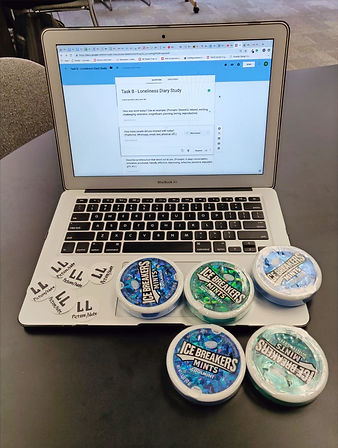

" I cooked lemon chicken and ate it with the members in a bible study group. I felt excited at such activity because it is one of few moments during a week that I do something other than studying alone. "
* Process Photo and picture & quote from the Diary Study Participant
Research Findings
We collected quantitative (screener survey) and qualitative data (interview and diary study) about Ph.D. students from various departments. We built and used a pivot table and affinity diagram to organize and synthesize our findings.

Affinity Diagram
-
Excessive workload & lack of social opportunity prevents Ph.D. students from making new connections.
-
Ph.D. students face distinct daily issues and can only be understood by people who have ‘been there'
-
Ph.D. students were often suffering from social isolation due to imposed self-sufficiency.
Pivot Table
-
The quality of interactions is more important than the volume.
-
Students feel most lonely during their first 1 to 2 years of their Ph.D. study.

Also, as part of our design process, we designed our personas that represent our user group and sum up our research findings more efficiently.
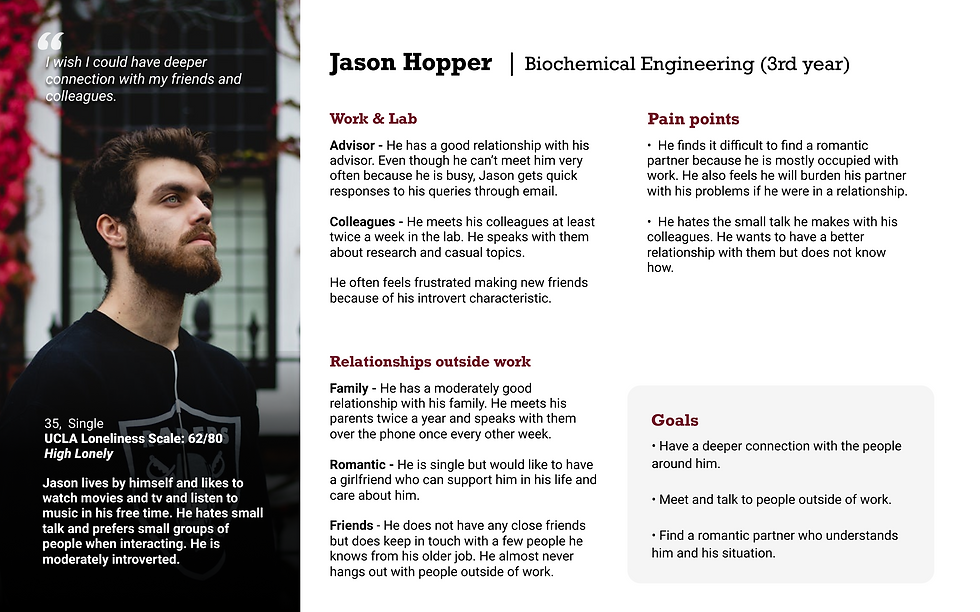

Ideation
We came up with 5 key questions as guiding metrics to qualify the problem-solution fit. Out of the five, the most important design problem we raised was:
“How can we improve the quality of connections Ph.D. students have within and outside of work?”
We came up with 10 different ideas and chose the “Connection app” idea to be our solution. We envisioned that the solution would encourage Ph.D. students to build deeper connections and share inner feelings with their close friends and family. We created our low-fidelity prototype and conducted usability testing to validate our idea.


-
Users can change their status and update their news to their friends' circle.
-
The app will send prompts based on user preferences to chat rooms to encourage conversation.
-
Share self deep feelings to friends circle anonymously.

Validation and Iteration
We spent a good amount of time analyzing our test results and came to the conclusion that our initial solution idea wouldn't truly solve the loneliness problem of Ph.D. students. We went back to the ideation process and decided to further refine the matching app idea to be our new solution.
Reasons for the failure - old idea
-
Closed circles do not need prompts to converse with one another.
-
The app isn't perceived by the students as particularly beneficial for Ph.D. students
-
Group and individual dynamics for close relations are usually set before they use the app. It's extremely difficult to change or improve the existing connections.
After deciding our new solution, the very first thing that we did was running a focus group with 6 Ph.D. students in order to avoid further failures. We ideated on features and created low-fidelity prototypes for usability testing only after validating the true need for the solution.
Reasons for the Success - new idea
Pair allowed Ph.D. students to make meaningful connections and build a strong relationship by
-
Connecting students who have a similar interest (both professional & personal) through the customizable filter for matching
-
Allowing them to establish social bonds by sharing stories (revealing personal interest)
-
Removing the burden of starting the conversation by giving them the prompt

*Low-fidelity prototype

*Usability testing
Pair
*Interactive prototype
Major Features and Flows

1. Create Profile
-
Fill in basic details to your Public profile
-
Fill in additional details whenever you want
Validated Assumption: People don’t want to spend a lot of time making profile

2. Edit Personal Profile
-
Add information to your Personal profile that you can reveal to your Pairs
Validated Assumption: Ph.D. students are curious to know the research details of fellow students

3. Pair with People
-
Use Match Settings to filter your preferences
-
View people’s public profiles (Interests, Goals, Research Details)
Validated Assumption: Some people are introverted and have difficulty in conversing with new connections

4. Start Conversation
-
Use smart prompts for easier conversations
Validated Assumption: Minimize the burden of revealing yourself to people when building new connections
.png)
5. Reveal Profile
-
View information your Pairs have revealed for you
-
Add, choose and reveal information more relevant to your Pair
Style Guide and Information Architecture

*Click to view Style Guide

*Click to view IA
Reflection and Next Step
The biggest take away from this project was the importance of validating the idea with the user at every stage. Our next step is to test our high-fi prototype, validate conceptual assumptions and fix usability issues, and validate the need for a Ph.D. Community feature for Pair.